Home / Platform / Revenue Cycle
Module 07 · Revenue cycle managementFrom encounter close to cash in the bank. One pipeline.
Charges capture on sign-off. A 10,000+ rule scrubber pushes first-pass clean above 98%. Remittances post themselves; denials triage automatically.
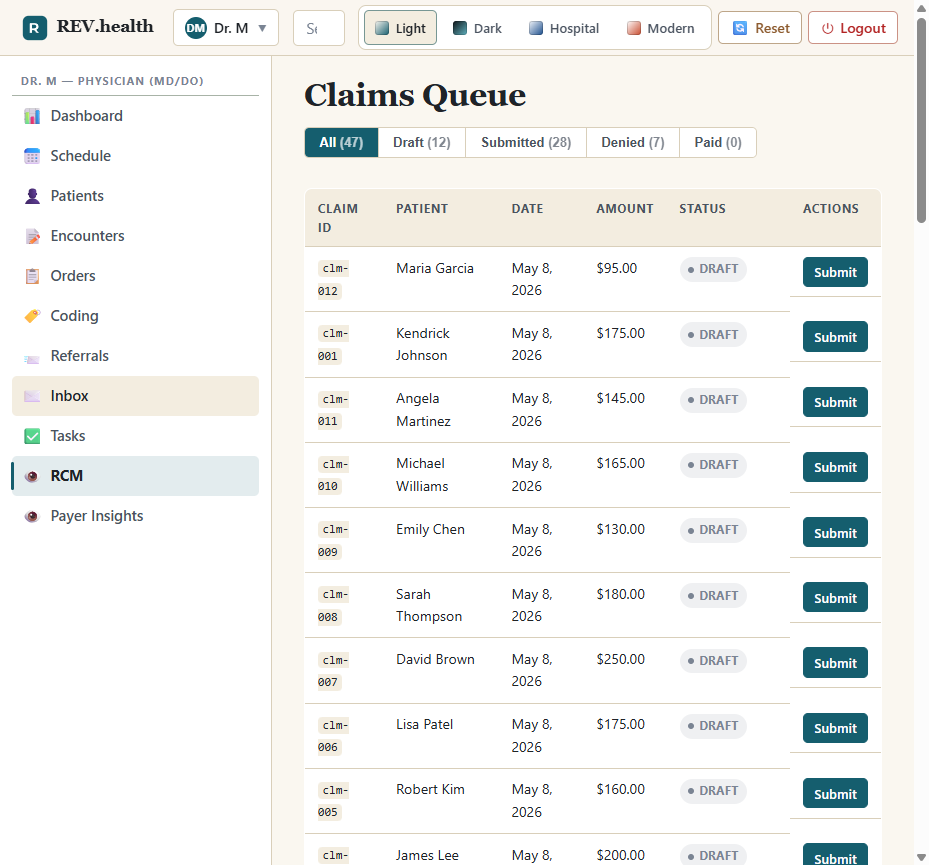
The signature pipeline
One claim, six stages, no clearinghouse portal.
From the moment a provider signs the note to the moment cash posts, the claim never leaves the platform. The scrubber's 10,000+ payer-specific rules are why the first-pass-clean rate clears 98% — problems are fixed before submission, not appealed after denial.
Five org-scoped entities carry the cycle — Claim, ClaimLine, Payment, Denial, PatientStatement — reading procedures and diagnoses from the patient's global clinical record at sign-off. Submission requires billing-manager authority (RBAC ≥ 70); coders scrub and edit but don't release.
The problem
Practices hemorrhage 5–10% of revenue through fragmented billing.
Charges manually abstracted from encounter forms. Modifier opportunities missed, NCCI pairs violated. Denials sitting in a queue with no triage and no SLA. Remittances posted line by line. Paper statements, trickling checks — and nobody watching days-in-AR in real time. Billing staff spend 70% of their time on rework instead of prevention.
Prevention beats rework
rev.health makes the entire revenue cycle native to the platform. Charges generate automatically from what was documented — procedures, immunizations, point-of-care labs — with modifier intelligence flagging conflicts before the charge leaves the encounter. The scrubber runs proposed codes against NCCI edits, MUEs, LCD/NCD policies, and custom payer edits, updated weekly. Problems are fixed before submission, not appealed after denial.
Money-in runs itself
Clean claims submit electronically with real-time 276/277 status tracking — no separate clearinghouse portal login. Inbound ERA/835 remittances auto-match to open claims and post, with contractual adjustments calculated from allowed vs. billed. Patient responsibility splits and routes to statements and online bill pay. Secondary and tertiary claims generate themselves when the primary adjudicates.
Key capabilities
The full cycle, in the box.
Auto-charge capture
Encounter close generates the charges — target: 99% of encounters produce a charge within 24 hours. Missed charges are pure leakage; the abstraction gap is gone.
10K+ rule claim scrubbing
Payer-specific rules library covering NCCI, MUEs, LCD/NCD, and custom payer edits, refreshed weekly. Conflicts resolve before submission.
837P submission + live status
Electronic claims through clearinghouse connectivity with automatic failover, plus real-time 276/277 status — acknowledgment, acceptance, or rejection without leaving the platform.
ERA/835 auto-posting
95%+ of remittance files post without manual touch. Contractual adjustments auto-calculate; denials categorize and route at posting time.
AI denial triage
Every denial is categorized — eligibility, authorization, coding, timely filing, COB, medical necessity — root-cause tagged, and routed to the right queue with an SLA clock.
Appeal letter generation
Appealable denials get letters pre-populated with claim data, clinical documentation, and regulatory citations — CMS manual language, state insurance law, payer contract terms. Deadlines tracked; none missed.
Patient statements & bill pay
Configurable statement cycles, online payment through the portal, payment plans with auto-debit, and credit-balance management.
Days-in-AR dashboard
Clean-claim rate, denial rate, first-pass resolution, net collection rate — real-time, with payer-level and provider-level drill-down and configurable alerts.
MIPS dashboards
Quality measures, promoting interoperability, and improvement activities tracked in real time — mid-year course correction instead of year-end surprises.
Workflow
A claim's life in rev.health.
Provider signs the note
Charges auto-generate from documented procedures, immunizations, and POC labs. Modifier intelligence flags a bilateral-procedure conflict before it becomes a denial.
The scrubber clears it
Proposed CPT/ICD-10 pairs run the 10K-rule gauntlet. One NCCI conflict surfaces for resolution; the rest of the batch passes clean.
837P out, status live
The claim transmits the same day. 276/277 shows payer acceptance within hours — on your dashboard, not in a clearinghouse portal.
The 835 posts itself
Allowed vs. billed computes the contractual adjustment; the patient's coinsurance routes to billing; the encounter closes financially.
The rare denial gets worked
AI categorizes it (CARC-coded), routes it with an SLA, and drafts the appeal with citations. First-appeal resolution target: 65%.
Who benefits
No more “we lost the charge” or “the claim was denied for a coding error you could have caught.” MIPS score visible on the dashboard.
Owns the cycle end-to-end from one surface: scrubbing, submission, posting, denials, collections — with claim status visible without a second login.
Collects patient responsibility at checkout with the amount already computed; sets up payment plans in a click.
Co-sign charges route to the supervising physician automatically; incident-to billing scenarios get modifier intelligence.
Performance targets
The numbers this module is built to hit.
| Metric | Target |
|---|---|
| First-pass clean-claim rate | ≥ 98% |
| Days in AR | ≤ 30 days median · ≤ 32 days platform KPI |
| Denial rate | ≤ 5% of submitted claims |
| Denials resolved on first appeal | ≥ 65% |
| ERA/835 files auto-posted without manual touch | ≥ 95% |
| Net collection rate | ≥ 96% |
| Encounters generating a charge within 24h | ≥ 99% |
| Patient payments collected online within 12 months | ≥ 40% |
| Claim scrubbing latency (full 10K-rule library) | ≤ 2s p95 per claim |
| 837P submission latency | ≤ 10s p95 · batch of 100 ≤ 60s |
| AI denial-categorization accuracy | ≥ 85% vs. reviewer consensus |
Standards & the back office it replaces
The whole clearinghouse stack, inside one login.
Clearinghouse connectivity runs with automatic failover, and every submission, posting, and triage event emits an OpenTelemetry span tagged by org, claim, and payer — so days-in-AR is a live number, not a month-end report.
Connected modules
The cycle starts in the exam room.
Clinical Documentation
Charge capture reads procedures and diagnoses straight from the signed encounter.
Module 01 →Eligibility
Coverage verified three times before the visit means denials prevented, not appealed.
Module 03 →Task Management
Every denial becomes a FHIR Task within a minute of 835 posting. Nothing sits unworked.
Module 09 →Get paid correctly the first time.
98% first-pass clean claims, sub-32-day AR, and a billing team that prevents instead of reworks.
Join the waitlist